The importance of having a strong social media presence can’t be over-estimated. It has become a cornerstone of a good marketing strategy, and it’s only becoming more vital.
The problem a lot of business owners face is that social media marketing can be incredibly overwhelming. There are so many rules, so many “don’ts,” and a still-pervasive belief that daily posting is excessive.
Not to mention, a good social media strategy requires a good amount of work. Still, you can do it. The goal should be to build your presence, and, as you build, you create a routine.
What holds a lot of businesses back is that social media still feels unnatural. Once you break through to where it’s a natural part of your day, you’re on the way to a strong, effective presence.
A few things to help you build your social media strength.
Integrate Social Media Into Your Overall Strategy
Social media should be a part of your overall marketing strategy, and vice-versa. For example, if you send out mailers or run ads in print, your social media handles should be included always.
Your offline marketing should be reflected on social media, too. If you’re having a big sale or have offered a special coupon offline, it should be featured on all of your social media channels.

Don’t make your social media a separate space from your website or physical location, make sure everything is tied together.
Content, Content, Content
When you think of social media, you might think of promotional tweets and Facebook posts. Those are definitely a part of using social media as a marketing tool, but promotional posting should be done sparingly — only about 30% of the time.
The rest of your posting should consist of content people want.
Often, the content people really want on social media is something they can consume instantly and (hopefully) share with their own followers.
Something relatable and relevant, and humor is a plus. Because, while social media is serious business to you, most of your consumer followers check social media for fun.

Relatable observations about your industry, funny or inspirational quotes, comics (shared from the original source or properly credited), memes, and quick tips are all good social media content, because they’re self-contained.
They can be consumed while scrolling a dashboard in one go, and are attractive for retweeting and sharing.
If you’re going to educate, put the data right in the graphic, like Ninja Economics on Twitter:

Offer Value
Value can come in several packages: If you have a retail business, many of your followers will be waiting for promotions — and, while social media should cover your overall deals and specials, it should also toss in an exclusive every now and then to keep followers on board.
But value is more than just giving people a deal. Value also comes in offering information they can use. Quick tip graphics are valuable, as are informational blog posts and tutorial videos.
Long-form informational content like articles and blogs should be linked with an image (you should always include a social media-friendly image with every blog you post), and a succinct, eye-catching teaser. The teaser, in most cases is the headline.
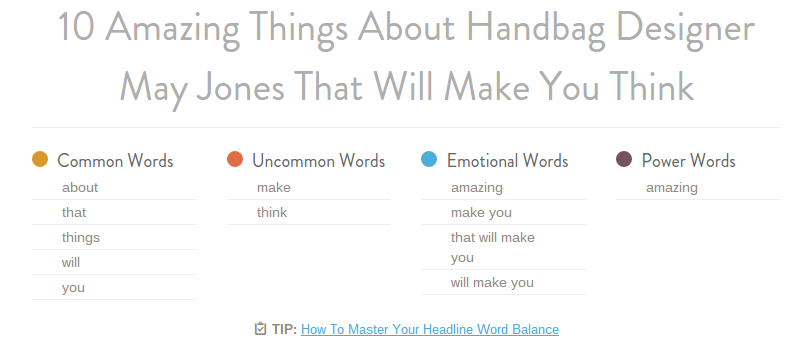
Make your teaser attractive, but don’t go too overboard. “5 Social Media Faux Pas And How to Stop Committing Them” is just click-baity enough to work, but “The World’s Best Social Media Advice” sounds like a late-night infomercial.
Ads are not seen as valuable on social media. You have to strip the feeling that you’re advertising on social media, even when you are.
Increase Your Traffic with Twitter
When you post a new blog post, don’t just post it to Twitter, strategically post it to Twitter.
Immediately after the blog has been published, tweet the headline, link, and a couple of relevant hashtags.
The hashtags are extremely important — if you have a long headline that doesn’t leave enough room for tags, cut down the headline.

Simply put, if you don’t tag your blog shares, no one will see them but your followers. Tags publicize them for the world.
You can find out the most often-used search terms in your topic by using Twitter Advanced Search option.
Create a Community on Facebook
If your Facebook page has people coming back for more day after day, you’ve achieved a strong social media presence.
The reason people generally don’t keep coming back is because they don’t feel any connection to it. Not just to you, but to other people who interact with your page.
A good way to create a community is to keep your followers engaged, with questions, contests, and discussions.
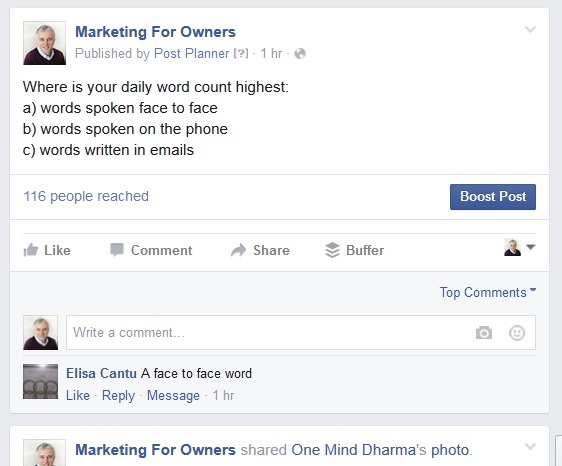
Ask followers “What are your top 3 favorite -?” People love to talk about things they like. Not only that, when people see other people liking the same things they do, they feel like they belong.
If people are having fun on your page, they’ll come back.
Utilize Linkedin
Linkedin is probably the most overlooked social media channel when it comes to marketing your business, in large part because it’s often considered nothing more than an online resume.
In reality, Linkedin is a dynamic channel that allows people to search for and connect with people who share an industry and/or a community.
The beauty of Linkedin is that everyone is there to market themselves and their businesses. You’re not interrupting the flow of vacation photos and celebrity tweets, there’s no pressure to be entertaining.

Basically, you’re networking on Linkedin, rather than trying to promote your business to potential customers (though it can be used in that way, too). And, as everyone knows, the right networking can propel your business.
Use Instagram Effectively
While most businesses pay most of their social media attention to Twitter and Facebook (and for good reason, they’re still the top networks), ignoring Instagram can cost you big time in social media presence.
While Instagram’s numbers are relatively small compared to Twitter and Facebook, Instagram users are generally loyal to the channel and have often stopped using the other two channels, so there is an opportunity to reach out to people with no overlap.
Instagram can be tricky — it’s not about sharing links (in fact, you’re only allowed one link on your profile and none in your postings), which is a huge part of other channels.

Instead, Instagram is all about aesthetics and imagery.
Retail companies use Instagram to show off high-quality photos of their products, drawing in new customers.
But the most effective way to utilize the Instagram platform is to create a lifestyle brand that goes beyond the products.
Which brings us to the next point:
Think Visual
Creating visually appealing content is vital on all social media platforms. Gone are the days when Twitter was simply a stream of compact text posts — today, images fill people’s feeds, and are the most likely to catch their eye. The same goes for Facebook.
Post a few visual posts with a text-only post interspersed, then check your analytics the next day. Unless you made one hell of a text post, you’ll probably see that the more visual posts caught more attention.
You can make simple text post (such as quotes or tips) more visual by creating a quick text graphic in Canva.

The few extra minutes it takes to create (with your branding, of course), will be worth the increase in visibility.
Interact
Never forget that social media is intended to be social, and is most effective when you interact with others.
The first type of interaction that is a must is responding to people who comment on your posts.
Depending on your volume of comments and responses, you may not be able to personally reply to all of them (good work!), but you absolutely have to reply to people on social media in some way.
Otherwise, you’re treating social media as if it’s a one-way street, a platform for you to promote yourself without playing by the rules.

Look at most celebrity Twitters. They are there for promotional purposes in most cases, and part of the job is to interact, often via Twitter “events.” Otherwise, they wouldn’t have near the same value.
You may not be a celebrity, but you want your company to be as well-known in your industry (even just locally) as one. So, answer questions, offer customer service, and thank them for any kind words. It’s part of the job.
Keep Tabs On Your Rep
You should always know what people are saying about you on social media. Generally, if someone mentions you by your social media handle, you’ll be alerted.
Sometimes, though, people will talk about you without the @ that triggers an alert, or refers to your business by its real name rather than its handle.
You can find such mentions by simply doing a search of your business name and handle. Or, for more in-depth results, use Social Mention, which will tell you how often your search term comes up and how many mentions are positive, neutral, and negative.

If you find that people are talking about your company in a less-than-positive light, you can handle the situation before it gets out of hand.
Final Thoughts
Social media is a challenge, and it does take work. If you’re still thinking of it as a “side thing,” it’s time to reevaluate and build up the presence your business deserves.
[hide_from accesslevel=‘free’]
Are You Ready To Start Doubling Your Business With Half The Effort?
If you have a business, whether it’s established or brand new, wouldn’t it be great to know how to use free and low priced modern marketing methods to boost the number of customers banging on your door and dramatically increase your profits? And with no technical degree, no sales staff and just a few minutes a day.
As a member of The Owners Club, you’ll get free access to the methods I used to bootstrap my company from zero to a million dollars in its first 12 months with no sales staff (it was actually $1,002,000). And the methods I’m using today to keep growing it beyond 97,000 customers with very little effort. Best of all, it’s absolutely free.
Go here to get started
[/hide_from]