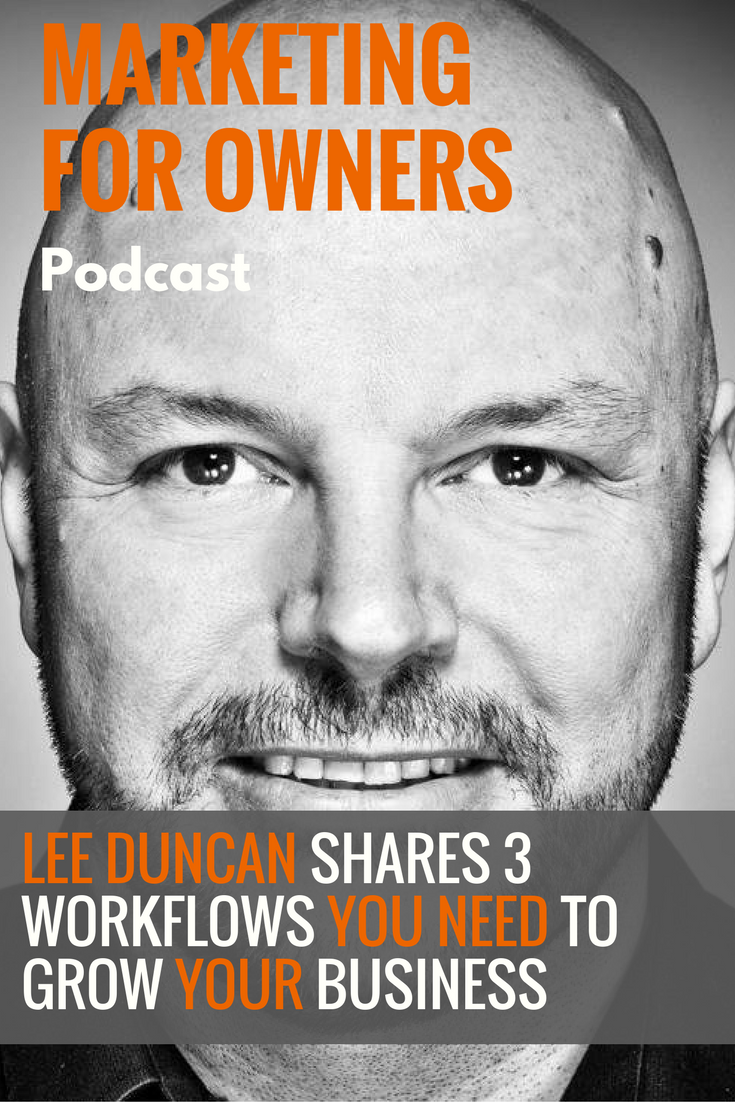
For Lee Duncan, author of Double Your Business, he was destined to work with small businesses. As a child, family conversations around the dinner table were always about business.
It’s also thanks to John Harvey Jones, from the 90s television program the Troubleshooter, who inspired him to help people in business when he was older.
However, he went to university and earned a degree in computer science. For a number of years, he then worked in the I.T. departments of large corporations, and at one point ran a department of 170 people with £28 million annual spend.
Click here to grab the Lee Duncan interview transcript >>>
It’s got his every word
[player]
Lee attended a course hosted by David Hemery (Gold medal winner in the 400m hurdles in the 1968 Mexico City Olympics), where he taught managers in large corporations how to cope and better manage a team. The approach he learned was to ask questions and help people to realise their own potential.
Just after the year 2000, he decided that he wanted to get out and do his own thing, and became a small business coach. Lee shares with us the approach he uses to help businesses grow by running more efficiently, so you can get started on doubling your business.
From Corporations to Small Businesses
In Lee’s coaching, he uses all the knowledge he acquired over the years, through training, reading and what he’s put into practice himself. And he has had sensational results in helping businesses to grow.
However, Lee did find that managing small businesses was a lot different to what he was used to in corporations.
Firstly, large corporations often offer training to their managers for everything they do. Whereas, in small businesses people can be inexperienced and don’t necessarily know how to handle every issue they come up against.
But a small business is a lot quicker at implementing changes and can, therefore, be more reactive. They don’t suffer from the same bureaucracy which sometimes delays changes which occur in corporations.
Work Out Those Kinks
Part of Lee’s role as an IT manager involved working with other departments; particularly manufacturing. And it is as a result of that, that he is familiar with The Theory of Constraints.
It is the idea that there will always be bottlenecks to everything, including business and manufacturing. It is something which holds back progress.
When there is a kink in a garden hose, the water cannot flow quickly.
And a production line can only produce as many products as their quickest machine. All but one of their machines may be able to produce 100 items an hour, but if one can only assemble 50 an hour, that’s the pace everything else has to work at.
So you have to find a way around it, such as making the machine work twice as hard or doubling the number of machines in that area.
Once you have identified that biggest kink in the business, you can focus your efforts on it. Little changes all help to make a difference in the grand scheme of your business.
For example, this may be the profitability of your business structure. It could be as a result of not receiving enough profit from the products you sell to cover their costs. Or, the costs are too high.
3 Workflows You Need Running Smoothly
To enjoy significant growth in your business, there are three flows which you need to get working right:
- The money flow – How cash flow and profit goes through your business.
- The sales flow – The way you get new customers.
- The work flow – Getting the work done.
You need to think about these flows and identify which has the kink causing you the most trouble. But you also need to ensure you are focusing on the right area first, otherwise, you’ll create more problems than you’ll solve.
Plus, it isn’t always the most obvious area which needs your focus first. So don’t just leap into solving an issue before you’ve thought it through.
Many people build a business which started out when they were working for themselves from home. As a result, the business may not have a structure which is ready to have levels of management and premises.
You need to look at the cycle of your business. It starts with identifying whether or not you’re making enough money to grow the business. Next is working out how you scale the business by getting more customers, and then increasing the work flow to handle the capacity.
Work Like Clockwork
Lee has always been able to find areas of improvement in every business he has worked with. In his book Double Your Business, he talks about the three stages of systemising your business.
To start, you need to ensure the business is stabilised. So you address those pressing issues which cause you problems on a day-to-day basis which get in the way of productivity.
When everything is working and running like clockwork, you then know the business is stabilised for systemisation.
However, once this is done, you need to still focus on the performance of those processes. There may well be a way in which you can change one to work quicker, more effectively or to produce larger profits.
When you do something all of the time, the issues you have can be irritating as well as invisible. You come to think of it as a fact of life, rather than something you may be able to avoid.
Sometimes you can also be too close to the business to be able to spot such issues. You need an outsider’s perspective to point them out to you.
When you’re in a maze it can be difficult. But when you have someone who has a bird’s eye view, they can guide you out of the maze with ease and precision.
Also, we all operate with our limited world view. Sometimes that experience can be a big benefit, but it can also be what holds you back. It may be that you need to step away from something you enjoy in your business, for the good of your business.
Double Your Business
Lee started writing Double Your Business in 2011, and in 2012 it was published. It is his take on how you should decide what to priorities in your business.
At the start of the book, he has included a self-diagnostic test. Over the course of around 100 questions, Lee is able to identify which area of your business you should focus on first. Whether that’s personal development, financial management and control, management, leadership and team building, marketing, sales, systemisation and customer service.
That enables you to jump straight to the chapter which is most appropriate for you to get a head start. Each area then has a handful of blueprints to help you out as you solve the kinks in your business.
After that, you can then go back and identify the next area which needs improving and then focus on that area. Soon, you’ll have a business which runs more effectively than ever before, allowing all the flows to work smoothly and enjoy the benefits that brings.
But Lee’s advice is to not wait until it’s too late, when things are really bad, before you ask for help. Making changes at the first signs of trouble can save a business.
And Finally
To learn more about Lee, and what he does to help businesses, you should visit his website. He has a blog and regularly hosts webinars to help you out.
Plus, you can download his Foot-in-the-Door Method which is about how you can reach customers who are incredibly difficult, whether they’re not taking your calls or not answering your emails.
You can also purchase his book Double Your Business which will help you to solve the problems you didn’t even know existed in your business, in order to get it ready to grow.
Connect with Lee