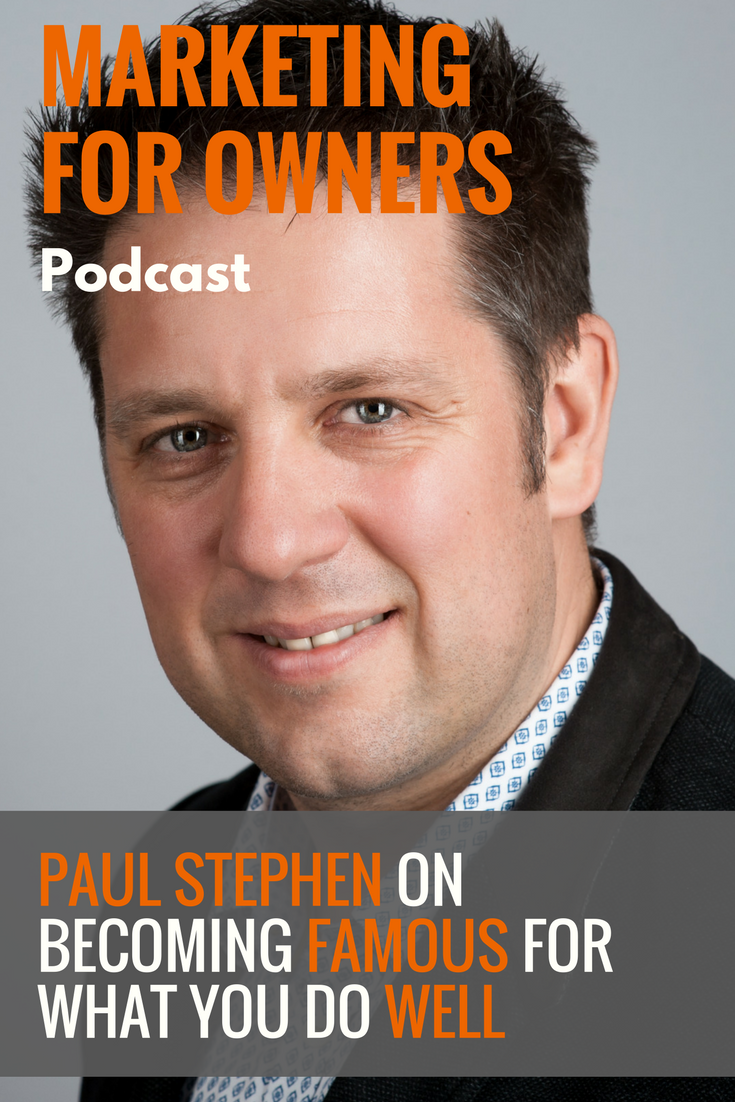
For well over 20 years now, Paul Stephen has been at the helm of a design agency which has enjoyed growth and success. It started with just two people, and now Sagittarius Marketing has more than 40 people who are a part of the team.
When Paul left school, he didn’t go to university and struggled to get a job. He wanted to be an illustrator and designer, but no-one would give him a job, and instead spent a few years working on building sites.
He eventually got a job as a kitchen designer (and salesman), which gave him the experience he needed to take with him to his next interviews.
He spent a few years as a freelance designer working with multiple agencies, giving him a network of contacts. In 1992, Paul joined forces with Simon Burn to form an agency.
Their first project was the launch of the Channel Tunnel in 1994 and used the money from it to do up a barn from which to run their design agency called Fireworks.
Click here to grab the Paul Stephen interview transcript >>>
It’s got his every word
[player]
Find out how they differentiated themselves in early days from the competition. But you’ll also discover how Paul is still proving themselves to be the best and how having a good workplace community is vital to the overall success.
Creating An Agency
By 1996, they had several clients and had to open an office in Toronto for the increasing numbers of Canadian clients which Simon went off to run. It also meant they were established just as the internet was growing, and meant their clients were coming to them for websites.
Having been fairly techy anyway, Paul just gave it a go as at the time when the internet had just been launched, there was no-one to learn from. So he made things up as he went along.
This is when having an office in Canada gave them an advantage. Although it provided no technical advantage, it almost gave them the chance to see the future, as generally, they were two years ahead of the UK in terms of how the internet was used on the other side of the Atlantic.
By 2001, he felt he was already getting to the limits of his technical ability and was hiring people who were more capable than he was at the new technology.
But the Canadian business was bought out, leaving just Paul to run the UK business with his small team. In 2003, he ended up taking over Sagittarius, another local design agency which he merged with his own agency.
After the merge, the Sagittarius team consisted of 25 people.
The Move To Digital
In the early noughties when pitching for a project, Paul was once branded as eccentric for suggesting they created smaller brochures in favour of including CD-ROMs which included pictures and videos.
Of the 25 staff, most of them were offline designers. But over the next eight years, he saw a gradual decline in design work for print and advertising. And where they once had all the print equipment in house, it was soon outsourced as it became no longer cost effective to own their own machines.
However, they did benefit from having a digital design team which was bigger than what many digital-only agencies had, and landed contracts for many big brands.
As part of the shift, the focus during this time was not only altering their own focus but also weaning their clients to digital as well for a greater return on their investment.
Where at the start of the decade they were focused mainly on direct mail and advertising, by the end, they were solely a digital agency. That was because it became increasingly difficult to create a team who could do everything.
To compete and stand out as more than just a local agency, the agency needed to change. They could no longer be all things to all people.
Instead, Paul needed to make a name for his agency which clients would choose over all of the other agencies which were around. After all, they were all pitching against each other for the same projects.
Find Your Proven Successes
By being known as the best at doing something, it means you’re in a stronger position to charge a premium and justify it. But when it came to choosing a niche, it had to be a gradual effort, rather than simply putting all of his eggs in one basket.
When you choose any service, you do it because you can’t do it yourself. Also, you want to pick someone who will do it better than you could, who represents good value for money and is a low-risk choice.
So he looked through their portfolio of work and found clusters of clients who were in the same industries. With already proven success in these areas, these were key for his focus.
With an understanding of the industry from his own experiences, he started with travel. The agency put on events and entered awards. Although it took a few years of continued focus, travel clients were soon coming to them, because Sagittarius were becoming known for doing good things in that space.
By speaking about the right things, rather than just everything they did, was significant to their success.
And it didn’t matter that they were doing the same things in other sectors because clients wouldn’t generally hear about what’s happening in other industries.
So with a few sectors which they primarily focused their efforts on, their success was more concentrated. But not only that, it meant the team was enjoying the process a lot more.
Constructing The Perfect Team
When it comes to being effective at delivering results in different sectors, the agency is essentially a collection of smaller agencies. These consist of small teams who all work together on their own individual parts of various projects.
For that to work, they all have to obviously get along and work well together. So the agency created a set of values which they want everyone in the team to share.
This consists of things such as being helpful and humble, being insightful and effective, as well as being remarkable and going beyond the call of duty.
When they interview people for a position, they are done so in line with those values. And only people who have a CV which makes them perfect for the role get an interview. When they have these values, they know the new hire will get along with the rest of the team.
More recently, they’ve used personality testing to find people for roles such as project managers, to ensure they are organised and structured.
In the past, they’ve hired people who were just not wired for the job of project managing. So they now look for people who share the same traits as those who excel as project managers in the agency currently.
Company Culture
It’s also important to have a strong company culture. For Paul and his team, when they almost doubled the size of the agency to more than 40 staff in a short amount of time, it would have been easy to lose the culture they had previously developed.
Thankfully, they managed to not only maintain it but to also make it even stronger than before. That’s because for the team to work, it needs to consist of people who want to be there and enjoy being a part of it.
Paul is ensuring he can maintain the growth they’re enjoying by preparing for it in advance and hiring people so they can manage an increase in workload. By looking for people before they’re needed, he can take his time to hire the right people.
By not hiring in a panic, he is able to carefully consider whether they share the values which will continue to make the company culture even stronger.
He is preparing by making sure he has a suitable answer to the question “what if the workload doubles?”
And Finally
Go to the Sagittarius website to check out the recent projects they talk about on the blog where you can gain a few insider secrets. And whilst on the website, you should check out the things they do as well as keep up to date with their latest events.
You can also find out more about Paul on his LinkedIn page where you can also connect with him.
Connect with Paul